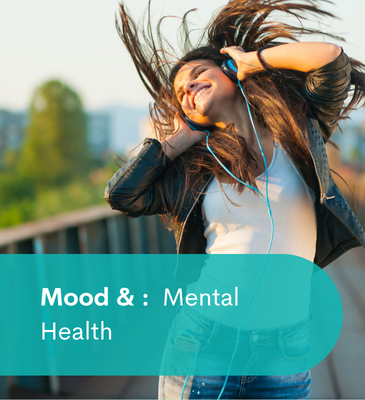

May is Mental Health Awareness month, and mood regulation is a crucial determinator of mental wellness.
How often do we hear someone declare that another is in “a bad mood?” How often do we feel as though our own mood is low and when it is, we lose motivation, avoid socializing and turn to comfort foods to lift our spirits (another term used for “mood”)
Mood is not something that can be seen on a diagnostic tool such as MRI or CT scan – however, significant work has focused on blood tests to discern potential markers of persistent low mood, or depression in an objective manner. For example, researchers found that there was a correlation between low mood/depression with amounts of brain-derived neurotrophic factor (BDNF), a protein that impacts mood through participating in changes in the neuroimmune axis.
What is Mood?
Mood is an overall feeling, an affect, an outlook that is a short-lived and low-intensity state. While it is not an emotion, it can be influenced by emotions. Emotions are fleeting and intense (e.g., sadness, fear, exhilaration, joy). Emotions are linked to mood, and they can affect as well as catalyze changes in it.
The official definition of mood from the American Psychological Association is: “A disposition to respond emotionally in a particular way that may last for hours, days, or even weeks, perhaps at a low level and without the person knowing what prompted the state. Moods differ from emotions in lacking an object; for example, the emotion of anger can be aroused by an insult, but an angry mood may arise when one does not know what one is angry about or what elicited the anger.
Therefore, it can be stated that an emotion is a reaction to an exogenous circumstance or occurrence, while mood is endogenous in nature; its neurochemistry is influenced by neurotransmitters and hormones (e.g., dopamine, serotonin, norepinephrine, oxytocin, glutamate and GABA) that collaborate to regulate mood.
Low Mood is not Depression
This is a critical distinction especially in the dietary supplement industry in the US, the FDA considers “depression” as a disease state. Therefore, formulating supplements for mood support offers an effective way to reach a broader consumer base. Most healthy individuals experience periods of low mood, even though they are not clinically depressed.
Low mood is non-disruptive and confined to emotional states such as sadness. In contrast, depression impairs daily functioning and is often accompanied by changes in appetite, sleep and interest in activities. Low mood is short-lived, while depression is longer lasting and may require medical/psychiatric intervention.
The Role of Adaptogens in Mood
Because adaptogens are known to enhance the state of non-specific resistance to stress, adaptogens such as ashwagandha may support healthy mood regulation. They tend to work by reducing the body’s response to a barrage of stressors.
A review on adaptogens notes many clinical trials found that consuming adaptogens provides an anti-fatigue effect enhancing “mental work capacity against a background of stress and fatigue, particularly in tolerance to mental exhaustion and enhanced attention.”
Previous research suggests that the stress-protective effect of adaptogens are mediated through regulation of the hypothalamic-pituitary-adrenal axis and other key mediators of stress response.
In traditional Ayurveda and Unani systems of medicine, the roots of Ashwagandha (Withania somnifera) have a long history of use as an adaptogen.is Today it is one of the adaptogen that consumers are most familiar with.
Ashwagandha root has been studied for its effects on mood health for years. In one 2001study, authors found that rats administered ashwagandha “exhibited an antidepressant effect, comparable with that induced by imipramine, in the forced swim-induced ‘behavioral despair’ and ‘learned helplessness’ tests. The investigations support the use of WS as a mood stabilizer in clinical conditions of anxiety and depression in Ayurveda.”
Prolanza™ for Mood Health
Prolanza™ is the only root-only, science-backed ashwagandha extract that helps support healthy mood regulation with one low dose which provides consumers with outstanding convenience, which increases likelihood of purchase loyalty.
Earlier studies have shown positive effects of Prolanza™. Pharmacokinetics data indicate that Prolanza™ delivers 11-times more USP-standardized withanolides than a competitive ashwagandha ingredient, reinforcing its superior efficacy at a fraction of the dose. With a clean-label, non-GMO and solvent-free profile, it meets the highest standards of safety and consumer trust.
A double-blind, randomized, placebo-controlled 90-day human clinical trial found that 300 mg of Prolanza™ not only reduced stress levels but also improved psychological well-being (i.e. mood) and sleep quality. .
The goal of a new human study was to determine whether half the dose – 150 mg Prolanza™ once daily would also offer benefits for stress reduction. The team evaluated the efficacy and safety of Prolanza™ at both 150 mg and 300 mg daily over 60 days in reducing stress and associated symptoms in healthy adults experiencing stress. Additionally, the researchers evaluated the supplement’s effects on mood, sleep quality, impaired eating habits and serum cortisol levels, all of which are affected by stress.
At the end of the study, the researchers found that both doses reduced serum cortisol and stress, with concomitant improvements in sleep quality, eating behavior, and overall well-being.
Taken together, the research evidence strongly supports that supplementation with Prolanza™ helps improve stress management and related outcomes, such as sleep and appetite.
Conclusion
A sustained bright mood is an indicator of good mental health. A healthy diet, regular exercise and positive lifestyle habits including one capsule of Prolanza™ daily can help support and maintain healthy mood.
Reviewed by Sneha Sawant Desai, PhD